Warren Buffett Gambling Agains Money Managers
Warren Buffett has won a big bet, and mainstream investors could be a chip better off — or at to the lowest degree more knowledgeable — because of it.
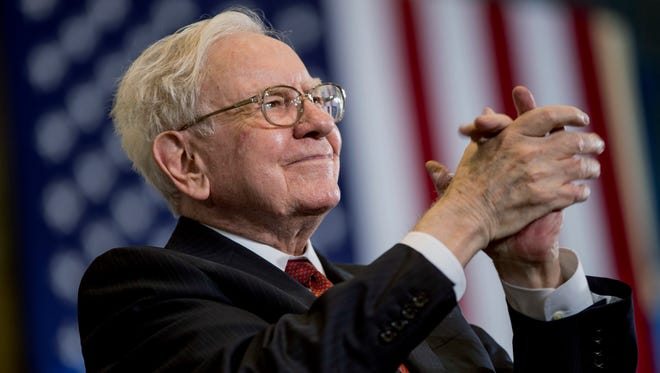
The billionaire from Nebraska revealed the last results of his 10-year investment bet, in which he wagered that a apprehensive stock-market index mutual fund could beat some of the brightest money managers on Wall Street.
The results weren't much of a surprise, considering that Buffett last twelvemonth revealed that he held a commanding lead. Both disclosures were made in little-noticed provisions in his annual letters to shareholders equally chairman of conglomerate Berkshire Hathaway.
Buffett made the bet in Dec 2007, arguing that a fund holding the same stocks as found in the Standard & Poor's 500 index could shell the combined functioning of a group of hedge funds over the following 10 years.
More:Warren Buffett: 'We've bought more Apple tree than anything else' in the last year
More than:Warren Buffett: Gambling on stocks is a losing investment bet
More:Warren Buffett was really bullish on this stock in 2017
Hedge funds are investment partnerships that cater to wealthy individuals and institutions. They charge high fees for their supposed financial acumen.
Cafe gave a progress report a yr agone, post-obit twelvemonth 9. In tardily February 2018, he provided the last results.
"Now I have the final tally — and in several respects it'due south an eye-opener," he wrote in his newly released Berkshire Hathaway alphabetic character to shareholders. Results from the Due south&P 500 index fund easily crush the hedge-fund rivals.
Buffett made the bet to publicize his confidence that a "virtually price-gratuitous investment" in an S&P 500 index fund, available to anyone with a few hundred or a couple g dollars to invest, would beat the results accomplished past high-end professional person coin managers.
Many of those managers restrict their services to millionaires and big institutions such as pension funds and college endowments
"American investors pay staggering sums annually to advisers, often incurring several layers of consequential costs," Buffett wrote. "Do these investors get their money'south worth?"
'Brains, adrenaline and confidence'
Buffett said he placed the bet with Protégé Partners, which picked five hedge "funds of funds" that aimed to outperform the broad market, equally represented by a simple S&P 500 index mutual fund.
Those five funds of funds together owned stakes in more than than 200 hedge funds, providing a broad sample of money managers with dissimilar investment strategies. (Buffett agreed not to disclose the funds' names. Protege didn't respond to a request for comment.)
Hedge funds are run by some of the well-nigh highly compensated people on Wall Street.
"This assemblage (of hedge-fund managers) was an elite coiffure, loaded with brains, adrenaline and confidence," Buffett wrote.
The managers of the five funds of funds had another advantage, Buffett argued.
"They could — and did — rearrange their portfolios of hedge funds during the ten years, investing with new 'stars' while exiting their positions in hedge funds whose managers had lost their bear upon."
Index funds, past contrast, typically don't add or drib stocks all that oft. Changes happen fairly infrequently, as when corporations sell shares to the public for the first fourth dimension, get acquired, go private or fall beneath a certain size or other threshold.
The concluding results of the bet, according to Buffett, provided a resounding victory for low-cost index funds over high-cost hedge funds. The returns over the 10-year period for the five hedge funds of funds ranged from a mere 0.3 pct to 6.5% annually.
A representative S&P 500 index fund generated an 8.5% almanac return.
Costs are crucial
Why the deviation? The higher investor-borne expenses charged past hedge-fund managers probable were primal. Hedge-fund managers don't merely have a share of the overall uppercase gains (in the range of xx percent) just accuse sizable ongoing expenses averaging 2% or and then yearly.
That'south in comparing to typical index-fund fees of around 0.two%, if not lower.
Trading activity and poor decisions by managers also likely played a role.
Warren Buffett But Ripped Cryptocurrency to Shreds Time
Past holding a adequately steady mix of stocks through thick and thin, index funds don't run the risk that a manager could make glaringly bad judgment calls similar selling stocks correct earlier a market place surge.
"During the ten-year bet, the 200-plus hedge-fund managers that were involved almost certainly made tens of thousands of buy and sell decisions," frequently responding to short-term market place gyrations or inconsequential news, Buffett observed.
What investors demand instead is "an ability to both disregard mob fears or enthusiasms and to focus on a few simple fundamentals," he said.
Buffett criticisms
Buffett's analysis doesn't sit well with numerous investment companies that employ legions of money managers who actively strive to beat the marketplace by selecting what they consider the most promising stocks.
Timothy Armour, chairman and CEO of Capital Grouping, which oversees the American Funds family unit, responded in his ain letter to investors that his visitor has many actively managed mutual funds that accept beaten representative indexes over fourth dimension.
Citing Buffett, Armour decried what he called the common myth that it's "impossible" for an investment manager to beat an index.
The American Funds do feature active managers — meaning professionals who try to select stocks they feel are likely to outperform, different alphabetize funds that maintain generally stable portfolios.
But in other ways, portfolios in the American Funds group resemble index funds, which ironically explains much of their success.
In particular, the company's actively managed funds, similar index funds, feature broad diversification, a propensity to stay fully invested, a long-term focus and modest shareholder-borne costs, averaging about 0.five pct annually for the portfolios Armour cited.
Conspicuously, it's not incommunicable for active fund managers to vanquish an index. Simply the odds are against that happening, and it is difficult for investors to predict which managers will go the job washed.
Buffett is warranted in his enthusiasm for index funds and in his criticism of loftier-cost alternatives.
Source: https://www.usatoday.com/story/money/markets/2018/03/07/warren-buffett-made-10-year-bet-his-market-strategy-heres-how-he-won/402823002/

Post a Comment for "Warren Buffett Gambling Agains Money Managers"